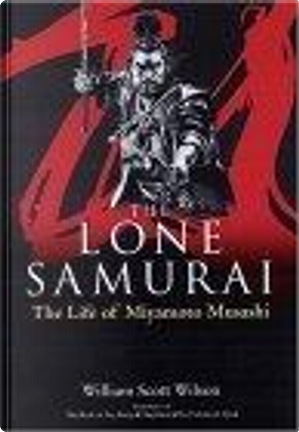
The Lone Samurai
The Life Of Miyamoto Musashi
Description
The Lone Samurai is a landmark biography of Miyamoto Musashi, the legendary Japanese figure known throughout the world as a master swordsman, spiritual seeker, and author of The Book of Five Rings. A stunning portrait of a courageous and singularly determined man emerges in these pages, the first biography of Musashi to appear in English. With a compassionate yet critical eye, William Scott Wilson delves into the workings of Musashi’s mind as the iconoclastic samurai wrestled with philosophical and spiritual ideas that are as relevant today as they were in his times. Musashi found peace and spiritual reward in seeking to perfect his chosen Way, and came to realize that perfecting a single Way, no matter the path, could lead to fulfillment. The Lone Samurai is far more than a vivid account of a fascinating slice of feudal Japan. It is the story of one man’s quest for answers, perfection, and access to the Way.By age thirteen, Miyamoto Musashi had killed his opponent in what would become the first of many celebrated swordfights. By thirty, he had fought more than sixty matches, losing none. He would live another thirty years but kill no one else. He continued to engage in swordfights but now began to show his skill simply by thwarting his opponents’ every attack until they acknowledged Musashi’s all-encompassing ability. At the same time, the master swordsman began to expand his horizons, exploring Zen Buddhism and its related arts, particularly ink painting, in a search for a truer Way.
Musashi was a legend in his own time. As a swordsman, he preferred the wooden sword and in later years almost never fought with a real weapon. He outfoxed his opponents or turned their own strength against them. At the height of his powers, he began to evolve artistically and spiritually, becoming one of the country’s most highly regarded ink painters and calligraphers, while deepening his practice of Zen Buddhism. He funneled his hard-earned insights about the warrior arts into his spiritual goals. Ever the solitary wanderer, Musashi shunned power, riches, and the comforts of a home or fixed position with a feudal lord in favor of a constant search for truth, perfection, and a better Way. Eventually, he came to the realization that perfection in one art, whether peaceful or robust, could offer entry to a deeper, spiritual understanding. His philosophy, along with his warrior strategies, is distilled in his renowned work, The Book of Five Rings, written near the end of his life.
Working from original Japanese source materials, author William Scott Wilson paints an unforgettable portrait. Wilson, of course, is also the translator who brought the English-speaking world the authoritative versions of Hagakure, Musashi’s Book of Five Rings, and other classics of martial arts philosophy.
Musashi remains a source of fascination for the Japanese, as well as for those of us in the West who have more recently discovered the ideals of the samurai and Zen Buddhism. The Lone Samurai is the first biography ever to appear in English of this richly layered, complex seventeenth-century swordsman and seeker, whose legacy has lived far beyond his own time and place.
- Where to Buy (Italy)
 Amazon
 IBS.it
 laFeltrinelli
 Libraccio.it